

Inspired by insights from my recent publication on modern diagnostic physical therapy.
When you’re in pain, the hardest part is often not knowing what’s wrong. Many people bounce between providers, wait weeks for appointments, and undergo unnecessary tests before finally getting the answers they need. My recently published research highlights a faster, more effective approach, one that centers physical therapists as first-contact providers equipped with modern diagnostic tools.
Today’s physical therapy is not what it used to be. With the integration of musculoskeletal ultrasound, electrodiagnostic testing, advanced clinical screening, and direct-access pathways, PTs can often diagnose, treat, and guide patients more efficiently than traditional referral models allow.
This article explains what that means for you and why starting with a physical therapist may be the smartest first step when you’re dealing with a muscle, joint, or nerve problem.

1. You Can Start With a Physical Therapist — No Referral Needed
One of the core findings emphasized in my recent publication is that physical therapists are highly effective as first-contact clinicians for musculoskeletal and neuromuscular conditions. What many people don’t realize is that you can see a PT directly, without a prescription or referral. You don’t need to wait weeks for a primary care appointment just to be told to “go to PT.”
As a first-contact provider, I:
-
Perform a comprehensive examination
-
Identify the likely source of your pain
-
Check for red flags or signs that indicate you need care from another medical provider
-
Refer you promptly and appropriately when needed
-
Begin treatment immediately when it is safe and indicated
-
Order or perform diagnostic tests when necessary
Physical therapists are specially trained to recognize when symptoms point to something serious—such as infection, fracture, systemic illness, or a neurological emergency. That means you receive safe, accurate, and efficient care from the very beginning.
Think of a first-contact physical therapist as your primary access point for muscle, joint, and nerve concerns—someone who ensures you start on the right path without unnecessary delays.
2. In-Office Ultrasound Provides Fast, Affordable Answers
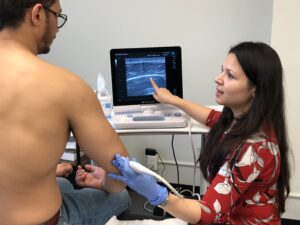
A key theme in my publication is the growing role of point-of-care musculoskeletal ultrasound in physical therapy. Ultrasound allows us to see soft tissue structures in real time like tendons, ligaments, nerves, muscles, swelling, and more.
This creates enormous benefits for patients:
-
No radiation
-
Immediate results
-
Dynamic imaging (we see tissues move as you move)
-
Cost-effective compared to MRI
-
Often detects issues that static imaging may miss
When I perform ultrasound during your visit, you see what I see. This clarity changes everything. Instead of guessing, we can pinpoint whether you have:
-
A tendon tear or inflammation
-
Bursitis or joint fluid
-
Nerve compression
-
Muscle strain
-
Ligament injury
- And sometimes we don’t find any structural issue or pathology at all, which can be very reassuring
The goal of my research and of my clinical practice is to shorten the diagnostic journey. In-office ultrasound lets us do exactly that.
3. Modern Physical Therapy Includes Advanced Diagnostic Testing — Not Guesswork
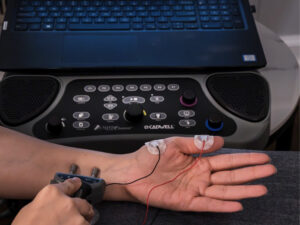
Another major focus of my publication is the shift toward diagnostic physical therapy, where PTs use technology traditionally found only in specialist clinics. At my practice, this includes:
Musculoskeletal Ultrasound
To visualize soft tissue and joint structures in real time.
EMG and Nerve Conduction Studies (NCS)
To accurately identify and localize nerve injuries, such as sciatica, carpal tunnel syndrome, or radiculopathy.
These tools allow us to answer critical questions immediately:
-
Is your pain coming from a nerve or a joint?
-
Is the issue in the wrist, elbow, or neck?
-
Is the tendon inflamed, or is there a small tear?
-
Are your symptoms coming from muscular overload or neurological dysfunction?
With a data-driven diagnosis, your treatment is no longer based on trial-and-error. It becomes targeted, efficient, and precise, just as highlighted in the research.

4. A Smarter Pathway That Reduces Cost, Delays, and Stress
The current healthcare system often forces patients to move through a long chain of steps—primary care, referral, imaging, specialist consultation before they can even begin effective treatment.
My publication underscores a different model:
One provider. One visit. One clear plan.
When you start with a PT who can examine, diagnose, and treat:
-
You begin the correct treatment sooner
-
You avoid unnecessary imaging or specialist visits
-
You reduce overall healthcare costs
-
You eliminate weeks of waiting
-
You feel empowered with clear information
-
You stay within a safe, evidence-based pathway
This streamlined approach benefits both patients and the healthcare system and it’s exactly the direction modern PT is moving.
What This Means for You
Whether you’re experiencing:
-
Neck or back pain
-
Shoulder or rotator cuff problems
-
Hip or knee pain
-
Tendon injuries
-
Numbness, tingling, or nerve pain
-
Foot or ankle injuries
-
Muscle strains
-
Unexplained joint pain
—you don’t need to guess where to start.
You don’t need multiple appointments.
And you don’t need to wait for months to get clarity.
Modern physical therapy supported by the findings in my recent publication gives you direct access to evaluation, diagnostic testing, and a clear treatment plan from the very first visit.

If you’re in pain and need clarity, you can begin here.
This approach is at the core of my clinical work and the research I publish:
better access, better diagnostics, and better outcomes.
Reference: Savage NJ., Nielsen RP., Nitz A, Rawat M and Steiner BU.K. (2025) Advancing first-contact, primary care physiotherapist practice: the value of integrating point-of-care diagnostic tools. Front. Rehabil. Sci. 6:1704822. doi: 10.3389/fresc.2025.1704822